
 by
by In game development, having a clear plan is crucial, and that’s where the Project Design Document (PDD) comes into play. For Gäelith. The Voice of the Stones, I’ve created a PDD to serve as the foundation of the game, guiding its evolution as I iterate and refine. Let me take you through its structure and how it ties into the Agile methodology and my development process.
A Flexible Approach
Agile methodology is a perfect fit for game development because it allows for flexibility, incremental progress, and iterative refinement. This approach ensures that the project can adapt to new ideas and challenges as they arise. For Gäelith, I’m dividing the project into iterations, with each iteration targeting a Minimum Viable Product (MVP)—a functional version of the game with a subset of features.
This iterative structure helps me stay focused on achievable goals while gradually building towards the full vision of the game. It also allows me to align development with my goal of mastering Unity. Each iteration can focus on specific aspects of Unity—programming, physics, lighting, or art—ensuring a well-rounded learning experience.
Iteration 001
The current PDD focuses on the basics of the game, covering core gameplay mechanics, visual effects, sounds, and user interface for the first iteration. The goal is to create an initial version of Gäelith that includes the foundational gameplay:
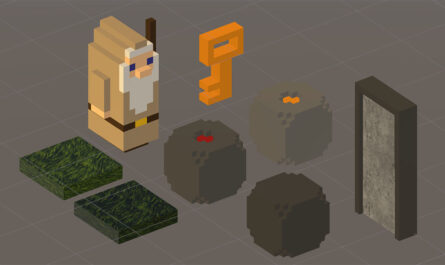
- Core Mechanics: Players control Gäelith, a druid with magical powers to interact with stones. The objective is to align three special stones in a row to unlock the portal to the next room.
- Room Design: Each room is an 9×9 grid with static and dynamic stones, special stones, and a portal door.
- Interaction: Gäelith moves, rotates, and pushes stones to solve puzzles, with additional reset and quit options.
- Effects and Sounds: From stones falling from the sky to Gäelith spinning into a portal, the PDD outlines the atmospheric and interactive elements.
This document is a living roadmap. As I progress through iterations, new features will be added, and existing ones will be polished.
Task Management with Trello
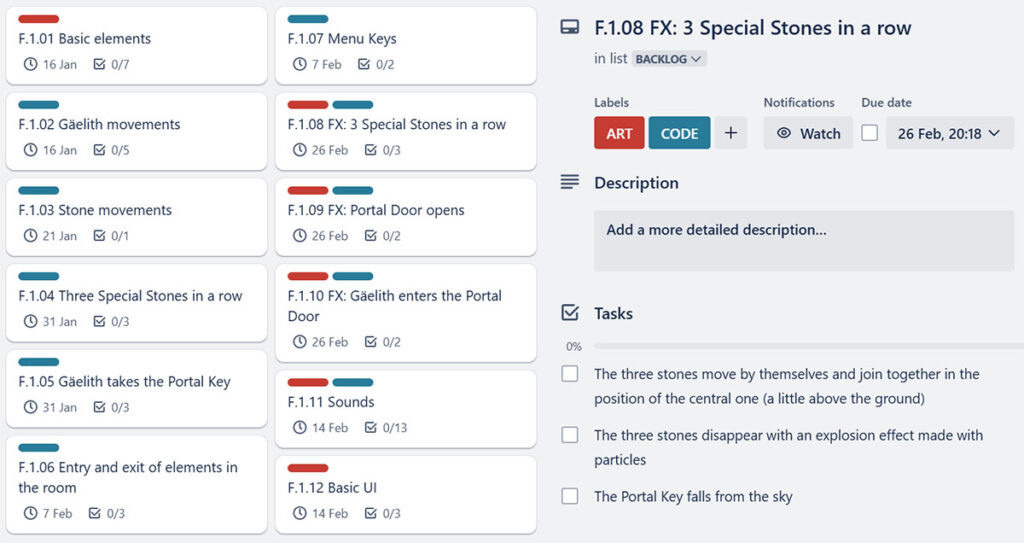
To keep everything organized, I’ve set up a Trello board with columns for Backlog, To Do, In Progress, and Done. Each feature in the PDD corresponds to a card on the board, but I’m not breaking tasks down into individual cards. Instead, each feature card includes a detailed task list that captures all subtasks needed to complete that feature.
This approach balances simplicity with detailed tracking, allowing me to monitor progress without being overwhelmed by micromanagement.
Download the PDD
If you’d like to explore the details of Gäelith’s development, you can download the Project Design Document here. It’s a comprehensive guide that outlines the first iteration’s features and goals, providing insight into the early stages of the game design process.
Creating Gäelith is as much about the journey as the destination. With each iteration, I’m not just building a game: I’m refining my skills, exploring new ideas, and connecting with the timeless themes that inspire me. Stay tuned for more updates as I continue to bring this vision to life!