 by
by Once the first iteration was completed and the Minimum Viable Product (MVP) was achieved—which you can see uploaded on this website—it is time to plan the next steps of the project.
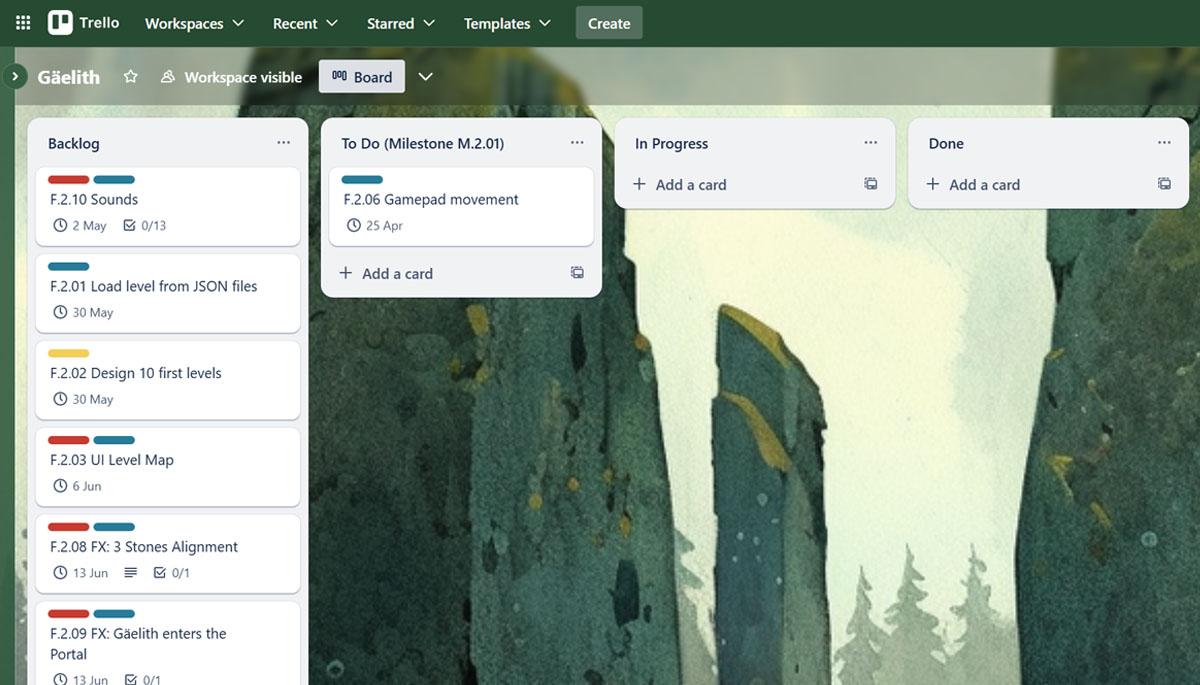
As could not be otherwise, and continuing with the agile approach, I have defined a new Project Design Document that describes and organizes the tasks to be carried out in this second iteration.
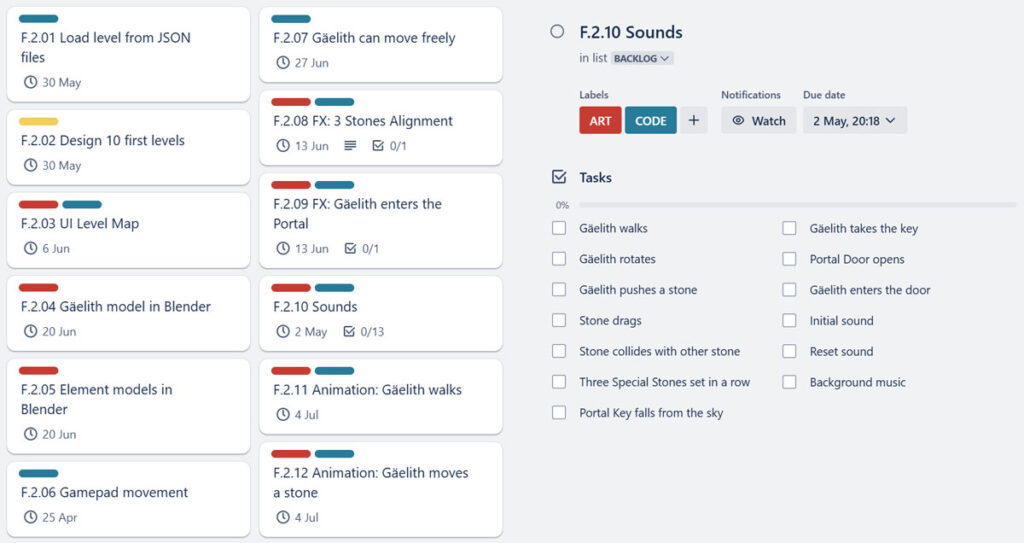
We could say that the main objectives this time are twofold: to improve the gameplay experience and to add complexity to the story.
Gameplay Experience
The first factor to consider regarding the gameplay experience is the visual aspect. It is time to replace the temporary models with more attractive ones, which I will model myself in Blender. Next, I will add effects and animations that will complete the visual aspect of the game.
Similarly, I will incorporate sounds into each of the actions and events that can occur in the game. In this way, I will enrich the sensations perceived by the player, as they will now experience the game through two senses (sight and hearing) instead of just one.
Story Complexity
In the first version, the stone blocks were distributed randomly. The way to increase the difficulty from one level to another simply consisted of increasing the number of blocks.
Now, the intention is to implement a level loading system that allows me to describe each level in an external file and thus be able to load it whenever needed.
At this point, it is time to demonstrate my abilities as a Game Designer. I will have to invent levels that spark the user’s curiosity, that are fun and challenging. It will be key to adjust the difficulty of each level so that it increases progressively and to avoid levels that are either too easy—which would end up being boring—or too difficult, which could lead to user frustration and possibly cause them to abandon the game.
Level Map
A good level system should be accompanied by a visual map where the user can check the levels they have completed and those they still need to finish, as well as the possible paths to follow if there are any branches.
This map should be attractive and easy to use. In addition to displaying the relevant information, it should be interactive, so that the user can access any unlocked level directly from the map.
Importance of this Iteration
If in the first iteration I laid the foundations on which to build the game, in this second one I intend to captivate the player. The basics are important; without them, the game would not work, but visuals and sound are the first things the user notices—they are the gateway to the product.
Once the player is hooked, the next step is to retain them by offering a good story. In the third iteration, I will address the development of elements that build that story, although with the level loading system I am already laying the groundwork to do so.