


 by
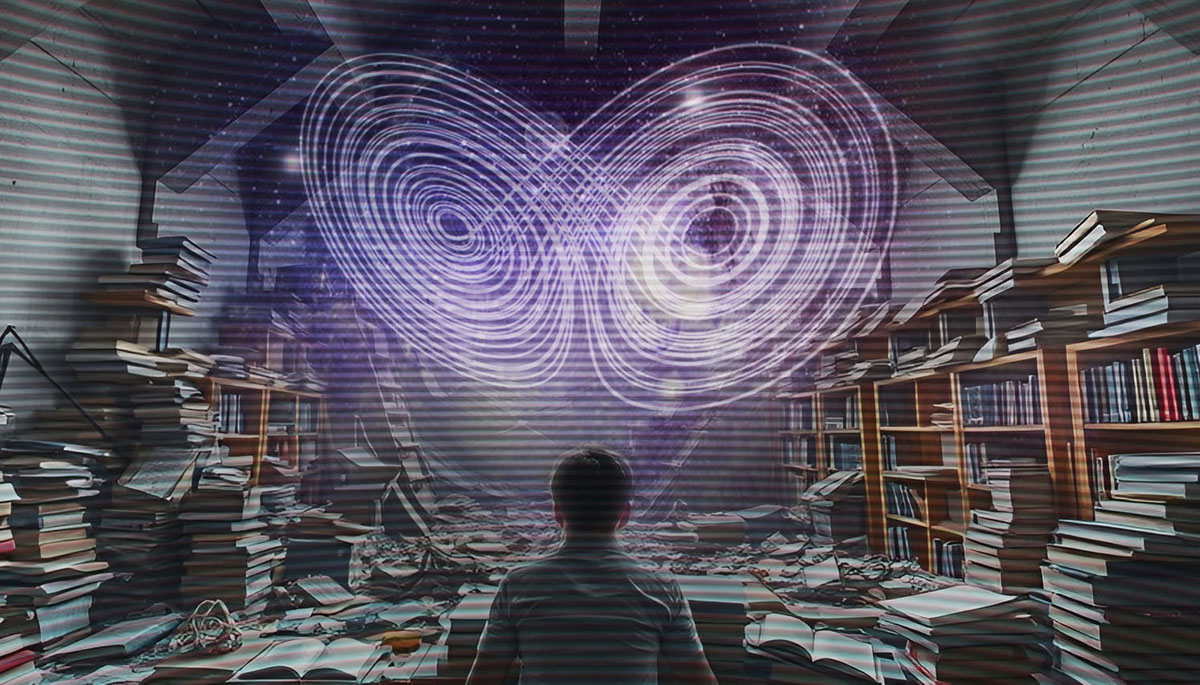
by I have always believed that it’s possible—or at least, that’s what I used to argue, quite convincingly, to my mother whenever I assured her that my room was, in fact, tidy. Of course, it was tidy according to my own criteria, so convoluted that it was indecipherable at first glance. But I’m neither the first nor the only one to make this claim.
In “Chaos: Making a New Science”, James Gleick tells the fascinating story of a handful of researchers from fields as diverse as meteorology, physics, mathematics, and biology, who began to sense something different in those chaotic data points that distorted and sometimes ruined their experiments. Figures like Edward Lorenz and Benoit Mandelbrot parade through the pages, each confronting that unknown monster that was (and still is) chaos.
The first attempts to tackle this issue were extremely challenging, largely due to the skepticism of the scientific community, which at the time dismissed small deviations in results as rounding errors or inaccuracies in initial measurements. However, that select group of curious minds saw something more: patterns that repeated themselves, though not in a strictly periodic way, and that could not only disrupt the balance of a system in the long run, but could also form their own chaotic structures, with a host of fascinating properties.
The book introduces key concepts such as the famous butterfly effect—that extreme sensitivity to initial conditions that means a small variation can have enormous consequences—and chaotic attractors, structures that explain how a system can display seemingly erratic behavior while still being governed by deterministic rules. Gleick shows us that chaos is not synonymous with absolute disorder, but rather a new way of seeing the world: complex systems that, although unpredictable in the long term, still follow underlying mathematical laws.
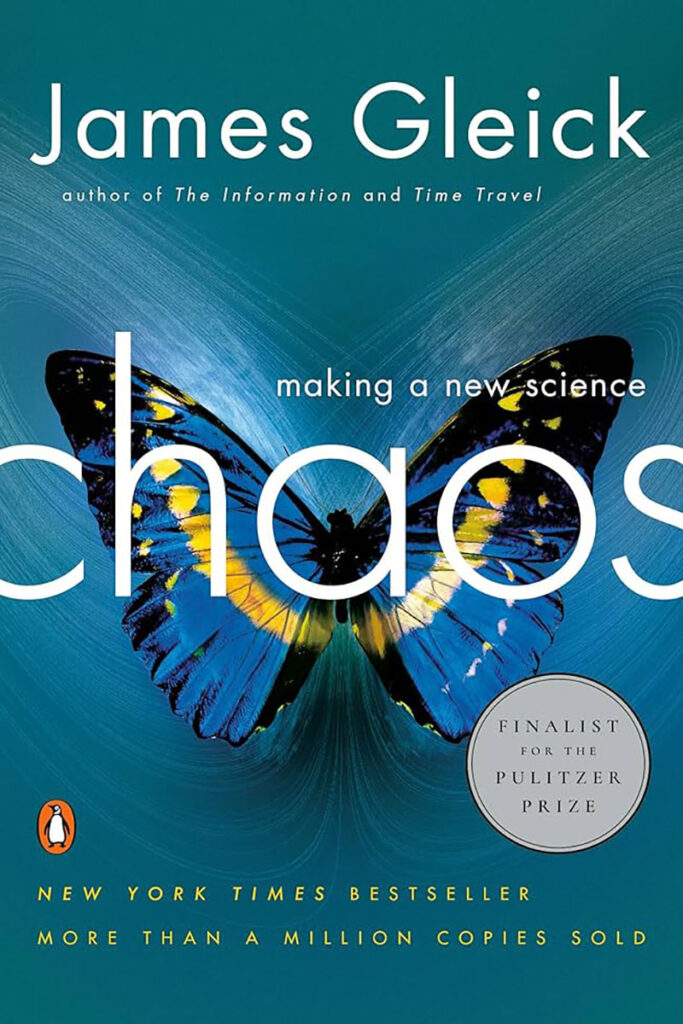
It’s no coincidence that each protagonist comes from a different field: chaos is everywhere, a fundamental component of our reality, and at any moment it can poke its unruly head in, ready to ruin even the best-laid equation. Over time, the various disciplines recognized that the “enemy” was a common one, and joined forces to create that theory as attractive as it is terrifying: Chaos Theory. You could say that this book is, in essence, its biography.
Gleick, who is a writer and science communicator but not a scientist, always uses accessible language, avoiding unnecessary technical jargon. The pages read like a scientific adventure novel, with some denser passages, but always focused on conveying the big picture rather than overwhelming the reader with complex mathematical proofs.
“Chaos: Making a New Science” is already a classic of popular science, ideal for those who want to befriend chaos without mastering in depth the disciplines behind it. Here you’ll find science, history, curious anecdotes, and the occasional striking diagram. After reading it, you gain a new perspective on nature, perceiving order and beauty where before you only saw disorder.
So now you know: the next time your mother scolds you because your room is a mess, you can reply—with scientific backing—that, in reality, it’s just a matter of finding the hidden order within the chaos.
